Author: Michelle

  • Pill Shaming

    Pill Shaming

    This morning I woke up and downed my medication. It’s something I do every day and it keeps my symptoms in check and allows me to function at a relatively high level. There have been times in my life when I didn’t need medication but coming off tends to lead to relapse. Throughout my illness I have been pill shamed – told that I didn’t need my drugs and that I was somehow weak to give in to the chemical haze that people expect. So what do these people say to me? 

    In some cases it was benign and trying to be helpful – “you’re stronger than that” or “you’re taking the easy way out” (doesn’t everyone?) – I understand they were attempting to reassure me but ultimately leads me deeper into anxiety as I am left in doubt as to my own weakness.

    Then there’s what I would consider the zealots. “Just try drinking hoby joby oil” or “Take up running”. All good (albeit strange) but the danger is that it encourages you to take their particular “treatment” in lieu of the pills. Running, in particular, is shown to help depression and anxiety but no self-respecting doctor tell you that it is a chance to come off their medication 

    “It’s only a placebo!”,. Maybe it is but you know what? I flipping love the placebo effect. If it’s the thing that gets me up in the morning, I couldn’t care less if it is down to the effects of the medication or placebo. 

    What really hacks me off is calling medication “happy pills”. No, they treat my crippling anxiety disorder and allow me to function.  The pills themselves don’t cause happiness, they just give some people the ability to get their anxiety to a level where they are able to tackle it (and if they decide to stay on the medication then that’s THEIR decision.

    In conclusion, some anxiety sufferers are able to manage their condition through CBT, eating a healthy diet and doing exercise but there are some of us out here who need medication to help. Not because I’m weak, not because the drugs are placebo, not because they’re happy pills, not because I haven’t tried running marathons. It’s simply because that’s what it takes for me to be me. And you don’t get more important than that. 

  • Anxiety Sufferers Answer Questions On Panic Attacks

    Anxiety Sufferers Answer Questions On Panic Attacks

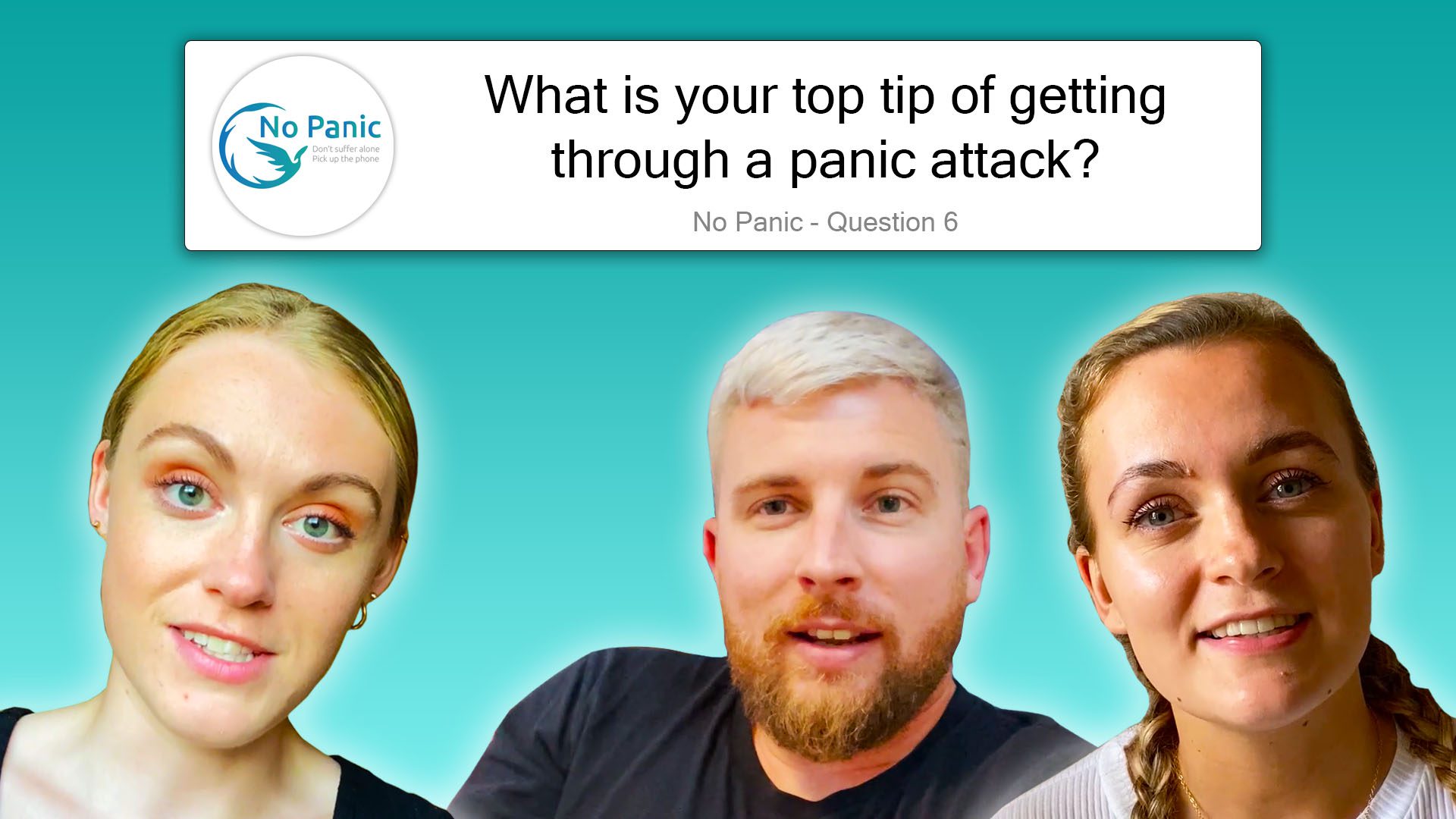
    Panic attacks are the most common subject that people come to us about here at the charity, which is why we teamed up with Dan from Mint Jelly Media to work on this project. By putting together a short video of people or have lived with anxiety we are hoping to help break down the stigma and get others to open up about the challenges panic attacks bring.

    You can watch the video here…..

    A huge thank you to Dan from Mint Jelly Media – Video Production Company https://www.mintjellymedia.co.uk/ and all the participants for helping us make this project a reality.

    How can No Panic help?
    No Panic specialises in self-help recovery and our services include:
    Providing people with the skills they need to manage their condition and work towards recovery.
    Our aim is to give you all of the necessary advice, tools and support that you will need to recover and carry out this journey. No Panic Recovery Programs

  • What is Mindfulness?  Interview with Bellsie

    What is Mindfulness? Interview with Bellsie

    So Bellsie, I can see that you’re desperate to start. So what on earth is mindfulness?

    Mindfulness was defined by Jon Kabat-Zinn, an American doctor who first conceived the Mindfulness-Based Stress Reduction (MBSR) course as; “paying attention in a particular way: on purpose, in the present moment, and non-judgmentally.” (Kabat-Zinn, 1994)

    What does that actually mean in practice?

    There are all sorts of different ways that mindfulness can be incorporated into daily life – from mindful breathing and body scans exercises to carrying out your normal activities (eating, getting dressed or even driving.

    Mindfulness is not a relaxation technique. There’s no tinkly music or whale song. It’s more a way of living.

    In some ways, mindfulness can be thought of as the contrary of the incessant rumination that develops with anxiety, choosing to observe the thoughts that pass through without passing judgment or interpreting their meaning.

    And how would that help with anxiety?

    Potentially it could help in different ways for different people. The main way that mindfulness has helped me is reducing thought-action fusion and thought suppression, but people also might just find that it makes them calmer and helps them to deal with stress in a more healthy way.

    Wait a second, what on earth is Thought-Action Fusion?

    Thought-action fusion (TAF) is a pretty common cognitive distortion that is often present in individuals living with anxiety, in particular, OCD and that falls within the larger category of magical thinking.

    What’s magical thinking? That sounds fun!

    Magical thinking is the attribution of causality to unrelated events and is the root of non-clinical superstitious behaviour as well as a component of anxiety and something that we all do.

    You mean like touching wood or saluting a magpie?

    Yep. Thought action fusion is a type of magical thinking and it comes in different types.

    Thought-action fusion can for example be defined as the belief that ‘having an unwanted, unacceptable intrusive thought increases the likelihood that a specific adverse event will occur ’ (which is known as likelihood thought-action fusion), or maybe ‘that having an unacceptable intrusive thought is almost the moral equivalent of carrying out that particular act’, (known as moral thought-action fusion) (Shafran & Rachman, 2004).

    So it’s like thinking of killing someone is as bad as doing it? Or that thinking about someone having an accident makes it more likely?

    Exactly. Mindfulness can be effective in helping the individual to view their thoughts as temporary and objective.

    And what about thought suppression?

    Thought suppression is exactly what it says on the tin – pushing away thoughts and trying as hard as you can not to “think” them.

    That makes sense though, doesn’t it? I mean if you have a thought that you don’t want then you should push it away, right?

    One of the defining characteristics of intrusive thoughts in anxiety is that they are seen as distressing and unwanted by the sufferer. The act of thought suppression is paradoxical in that the harder one tries not to think of something, the more frequent the thought becomes.

    Really?

    Yes. Let’s do a quick experiment (this is one of my favourite examples!). I want you to try your hardest not to think of a pink elephant for a whole minute. Are you ready? Go.

    Well that didn’t work.

    No. You see, it’s like I said – the harder you try not to think about something, the stronger it becomes.

    Research has shown that not only is a tendency towards thought suppression correlated with obsessional thinking, but also that people with anxiety and particularly OCD are more likely to put the inevitable failure to suppress their thoughts down to their own personal psychological weakness (Tolin et al. 2002).

    Mindfulness, as I said earlier, invites individuals to regard their thoughts as temporary and objective. Instead of trying to push the thoughts away, mindfulness teaches people to experience the thoughts without judging them or trying to control their content or frequency. One could argue that mindfulness would therefore prevent the thought suppression paradox from occurring.

    So are you saying that mindfulness could be used to treat anxiety?

    The current research findings indicate that mindfulness has a potentially positive effect in the treatment of anxiety, generally when integrated with CBT.

    One possible criticism of mindfulness is that it could become a form of neutralisation, thus becoming a ritual itself and reducing the effect of ERP interventions. It is important therefore to clarify that mindfulness is neither a distraction technique nor a relaxation exercise, but a state of mind, congruent with the immediate reality.

    Wow Bellsie! That sounds really interesting! Where can I find out more about mindfulness?

    Why thank you! There will very likely be courses going on around where you live, but you can also find all sorts of resources online.

    Check out Be Mindful – full of interesting things.

    I would also read Jon Kabat-Zinn’s book Wherever You Go, There You Are or listen to one of the many audio recordings out there.

    But above all – don’t be scared to give it a go. And keep at it – even just for a week or so. You might discover that it isn’t for you, but you might also find that it opens up a whole new way of living.

    You might like to try this No Panic audio to give you a taster: https://nopanic.org.uk/a-moment-of-mindfulness-video/

    How can No Panic help?
    No Panic specialises in self-help recovery and our services include:
    Providing people with the skills they need to manage their condition and work towards recovery.
    Our aim is to give you all of the necessary advice, tools and support that you will need to recover and carry out this journey. No Panic Recovery Programs
  • A Clear Mind and Calm Heart. Anxiety and Acupuncture

    A Clear Mind and Calm Heart. Anxiety and Acupuncture

    Mental health and needles? Helping to achieve a clear mind and calm heart? Surely not I hear you say! However, the reality is that increasingly Acupuncture as a form of Complementary and Alternative Medicine (CAM) is being sought and used in the treatment of mental health conditions including Anxiety and Post Traumatic Stress Disorder (PTSD).

    In England, 1 in 4 people will experience a mental health problem of some kind each year, (1) and the year 2020 brought about unprecedented change to all our lives, a global pandemic and has led to a concerning increase in reported mental health symptoms. We will be dealing with the medical, both physical and mental, and economic impact for many years to come. Mind (2), the mental health charity, states that since the outbreak ‘more than half of adults and two-thirds of young people said that their mental health has gotten worse during the periods of lockdown restrictions,’ and that ‘loneliness has been a key contributor to poor mental health.’ The reality is that anxiety is not something that anybody should suffer in silence about, the numbers clearly show that anxiety is highly significant in our society and something that people need to speak openly about and understand what treatment options are available.

    Research has shown that acupuncture can help to treat the symptoms of anxiety and the amount of high-quality research being carried out to study the efficacy of acupuncture for several conditions including anxiety is increasing. Studies show acupuncture can be an effective treatment for anxiety, with few side effects and serious adverse events are rare. Acupuncture is thought to stimulate the central nervous system, thus releasing chemicals into the brain and the spinal cord. Biochemical changes help to bring about homeostatic balance. The body’s natural healing response is triggered, consequently bringing about improved physical and emotional health.

    As a person-centred approach to treatment, Five Element Acupuncture addresses the balance at a mind, body, and spirit level, therefore treating at a root cause level rather than simply addressing individual symptoms. By firstly addressing any blocks, and then moving on to treat the spirit, the mind and the body begins to heal. When the spirit becomes distressed imbalance occurs, manifesting in symptoms. Anxiety is diverse, presents differently in each patient, it can be chronic or acute. Depending on each patient’s constitutional factor the emotional root cause will be different, and the symptoms will manifest in an individual way. Many treatment options and point combinations are therefore feasible and are person-centred and individualised.

    As we unfold through the complexities that recent events have brought, we acknowledge that 2020/21 has brought about many challenges with a considerable increase and exposure to stressors, but with challenges, we have hope and optimism as we navigate into the future. The global pandemic has changed our lives in many ways, the way in which we work and how we live, but it has also brought about greater openness and a wider discussion about our mental health. Clinicians and practitioners are at a critical juncture to consider patient needs more than ever and we must all think differently about how we approach mental health wellness and draw nationally and globally on both ancient teachings and new emerging treatment options. We move forward collectively, to bring about balance, and positive emotional, mental, and physical health.

    Julia Ugrinic is the owner of Green Rose Acupuncture and is a Five Element Acupuncture practitioner covering Telford, Shrewsbury, and surrounding areas in Shropshire. As part of Julia’s final year Acupuncture course, she focussed on the benefits of Acupuncture in the treatment of mental health conditions such as anxiety and Julia currently treats patients with conditions including anxiety.

    References:

    How can No Panic help?
    No Panic specialises in self-help recovery and our services include:
    Providing people with the skills they need to manage their condition and work towards recovery.
    Our aim is to give you all of the necessary advice, tools and support that you will need to recover and carry out this journey. No Panic Recovery Programs

  • Anxiety in the Classroom – A Teacher’s Story

    Anxiety in the Classroom – A Teacher’s Story

    After having taught in primary schools for the last decade, I have come to realise that there are countless ways that children display signs of anxiety at school. Some of these, of course, are more obvious than others. For example, a young child might scream, shout, cry or kick as they come into school out of anxiety over leaving parents or carers. Similarly, this might happen at the end of the day if a child’s parent is a few minutes late.  Often, children crave constant reassurance, which might display itself through persistent calling out during whole class inputs, or through always getting out of their seat to come and speak to you – both of which might sometimes just be called ‘bad behaviour.’  

    I once taught a child who needed to bring a toy from home everyday and would always need it within his eye line, even during PE lessons when it would sit on the hall piano. Every day he would also claim to feel ill in the hope that he would be sent home. It turned out that his parents were going through a difficult break-up and he was worried about his mum. I know that any teacher will be familiar with children who pretend to be ill – a classic sign of anxiety.  This year I have taught a child with selective mutism. Although she would happily talk to her good friends, she was extremely uncomfortable in groups with unfamiliar children and would completely freeze if asked a direct, personal question by an adult or asked to contribute to class discussions. We had to ensure we didn’t make eye contact with her when trying to have a conversation and removed any expectation for her to join in large group discussions. She was still able to make good progress, without the anxiety always hanging over her that I was about to pick on her. Children with other mental health issues such as ASD (Autism spectrum disorder) or PDA ( Pathological demand avoidance) also demonstrate their anxiety over school expectations through a wide range of behaviours – refusal to complete work, running away from the classroom, playing on their own, playing too physically, curling into a ball etc. 

    Some children’s anxieties are displayed in much more subtle ways. For example, they might display their concern over what other children think of them by using a silly voice to try and seek approval.  They might ask to use the toilet frequently during a lesson in an attempt to avoid the learning. I have sometimes caught children sneaking ‘pretty things,’ pieces of blu tack or shreds of paper into their pockets that they then use to play with later in the day during whole-class learning. This gives them the opportunity to distract themselves from lessons they might otherwise find stressful, or gives them something to do with their hands.  

    There is no single way to help children who are suffering from anxiety, just as there is no single reason for their anxiety or one single way that their anxiety manifests itself.  My biggest tip would always be to build a strong relationship with every member of your class. Without this, you won’t be able to spot the subtle signs children often show that they have worries. On the last day of term, I caught a boy in my class looking for a spare sunhat over lunch and fretting that he hadn’t brought his own hat. A sociable boy who would never normally care about such things, I knew that he had come inside because something else was worrying him. This child was clearly worried about the holidays and about not having the continuity of school. I wouldn’t have picked up on this if I hadn’t known him and his personality well. But instead, I was able to have a reassuring chat with him.  It is also imperative that you build strong relationships with the children’s families and make sure that they know how to contact you. Otherwise, you will often be left unaware of any external issues that may be causing anxiety for your class.

    Strong relationships, of course, benefit all children, as do any measures you put in place to support anxious children. Using a visual timetable will help prepare all children for the day ahead, but particularly helps any anxious children who may feel concern about the unexpected nature of school. Building routines into the school day will have the same effect. My recent class all insisted that we looked at the timetable, worked out the date, chose the children for class jobs and talked about how we were feeling every single morning and would correct me if I missed anything out. A routine in the morning really helps create a secure start to the day for any children that struggle coming in. 

    Finally, staying calm no matter what is happening is a difficult skill to master, but it is so important that you try as much as possible not to let an anxious child feel that you have lost control of a situation. A few years ago, I taught a child who was eventually diagnosed with PDA. One day, we had to evacuate the classroom when he started throwing chairs. The deputy head stayed in the classroom with him, with my Learning Support Assistant watching on. She later reported to me that the deputy head stayed completely calm even as the boy destroyed the classroom around her, throwing tables at the electronic whiteboard and hurling objects at her. After he calmed down, she then became the person that he always elected to spend time with when he was too distressed to be in class. Clearly, her calm approach helped him realise that no matter what he did, she would always be in control.

    By Jess (Key Stage 1 Teacher)

  • Chocolate Bears & Intrusive Thoughts

    Chocolate Bears & Intrusive Thoughts

    Like any self-respecting French student, I have a two-hour break for lunch each day. It’s just enough time for me to walk the 25 minutes home, stopping off to buy my baguette on the way (unfortunately not wearing a beret or with a string of onions or garlic draped around my neck). Yesterday, as I was leaving the boulangerie I walked past the shelf full of pick and mix, including a huge box of chocolate bears. Suddenly, the thought struck me that I could steal one and that nobody would know. I quickly brushed it away and went on with my day, but it made me think about the universality of intrusive thoughts, something that is sometimes hard for someone with OCD to understand and accept.

    In 1978, Stanley Rachman and Padmal de Silva interviewed 8 patients with OCD and 124 non-clinical subjects (people who didn’t have OCD) about the presence of intrusive thoughts and impulses that were deemed to be unacceptable by the respondents, as well as how frequent they were and how easy to dismiss. The results were fascinating –  to quote directly from the paper…

    To conclude Study I, obsessions (thoughts andior impulses) are a very common experience. There are no sex or age-related differences in occurrence, and most thoughts and impulses are easily dismissed. There are individual variations in the threshold of acceptability of obsessional thoughts or impulses.

    – Rachman & de Silva (1978)

    They then looked at the content of these intrusive thoughts and urges – can you guess which of the following lists were intrusive thoughts reported by the 8 people with OCD and which were reported by the 40 individuals in the non-clinical group?

    Were these impulses and thoughts from people with or without OCD?

    Intrusive thoughts and urges –

    Impulse to jump out of window
    Impulse to attack and harm someone
    Thought of ‘disgusting’ sexual acts with males (male subject)
    Thought whether he has been poisoned by chemicals
    Thought that his eyes will be/are harmed

    What about these ones – OCD or not OCD?

    Impulsive thoughts and urges –

    Thought that she, her husband and baby (due) would be greatly harmed because of exposure to asbestos, with conviction that there are tiny asbestos dust particles in the house
    Thought whether any harm has come to his wife
    Impulse to shout at and abuse someone
    Impuise to crash car, when driving
    Impulse to attack and violently punish someone

    The answer is that the first list comes from people with OCD and that the second list is entirely thoughts and urges reported by people from the non-clinical group. Don’t worry if you didn’t guess – Rachman and de Silva then presented the lists to a group of psychologists, and to quote from the paper –

    It appears that the judges were not able to identify the clinical obsessions too well, but on the other hand they were moderately good at identifying non-clinical obsessions. From this we can conclude that clinical obsessions are not as readily discernible-even to experienced clinicians-as might be expected.

    Rachman & de Silva (1978)

    Back to the chocolate bears. I was able to brush this thought away, to see it as illogical and ego-dystonic (inconsistent with my beliefs and personality – in other words, I’d never steal. I’m far too much of a wimp) and therefore not concentrate on it, but this isn’t always the case. Had my OCD seized upon the thought, I could have interpreted it very differently, tangling myself into a web of doubt and worry over what it meant. How could I think such a thing? What does that mean? Does it make me a terrible person?

    Take the classic CBT model of the vicious flower (see below), the trigger (the thought that I could steal the chocolate) would be misinterpreted as “I am a terrible person, probably a thief or a criminal”, which would cause emotional reactions (guilt, distress etc.), safety behaviours (trying to push the thought away) and neutralising actions (asking for reassurance that I wasn’t a terrible person, trying to rack my brain to see if I had previously done something similar etc.). I would probably try to avoid going into shops where I could steal, and soon my life would be revolving around this thought.

    And yet this didn’t happen. Instead, I went home, had a very nice ham sandwich and went on with my day.

    It’s a funny old thing, OCD, isn’t it?

    TD&M Bellsie

    THE VICIOUS FLOWER

    How can No Panic help?
    No Panic specialises in self-help recovery and our services include:
    Providing people with the skills they need to manage their condition and work towards recovery.
    Our aim is to give you all of the necessary advice, tools and support that you will need to recover and carry out this journey. No Panic Recovery Programs

  • The Beauty of Tears (Why crying can be good for anxiety)

    The Beauty of Tears (Why crying can be good for anxiety)

    ‘Why so sad?’ ‘Why the long face?’ ‘You’re so much prettier when you are smiling.’  And some other such questions and comments came to me as a child.  Perhaps you heard them too.  Really?  What are we supposed to do?  Explain? Share our pain?  I don’t know about you but I like to cry in private.  When I am feeling sad, bad, mad or hurt, sometimes I just need to cry it out.  If I am feeling worked up over something that has caused me to feel anxious or overwhelmed I feel better if I cry.

    Crying means that feelings are moving through us.  It means that our hearts are human hearts made of flesh and not stone.  They feel.  Those of us who are empaths or highly sensitive know this already and those of us who aren’t will also know the relief that tears bring.  It hurts to feel bad in one’s self, to experience pain, grief, shame, self-doubt or anger that has turned inward.  While we can’t cry on cue, if we do cry as a result of our powerful feelings by the end of the day or by the time the sun rises on a new day we will be feeling better.  Even a little lighter.

    If we can remember in the moment to be kind and gentle with ourselves as we would with a little child or a friend we will find the calm centre in the tornado of feelings and be reassured that ‘this too shall pass.’  I know that some things don’t simply pass.  A chronic illness, loss of a loved one will not pass, for example.  But as wisdom says if you want guidance, enquire within.  We often need quiet time with ourselves when heightened emotions come at us.  If we can get ourselves to a space such as a place of worship or the park, we can allow our feelings a healthy outlet through tears if need be.  

    And when they have come, we can acknowledge that we were courageous to be with them and strong enough not to have given in to greater despair.  In this way, we can open up once again to the free-spirited hope that lives inside of us.  This is but one way of looking at the beauty of tears.  I am sure that you have shed your own tears and have your own story to tell.  

    How can No Panic help?
    No Panic specialises in self-help recovery and our services include:
    Providing people with the skills they need to manage their condition and work towards recovery.
    Our aim is to give you all of the necessary advice, tools and support that you will need to recover and carry out this journey. No Panic Recovery Programs

    Mary Peters

  • Dentophobia (Fear of Dentists)

    Dentophobia (Fear of Dentists)

    Dentophobia is the fear of going to the dentist, and it is not something to be taken lightly. This fear can result in painful tooth conditions, tooth decay and a debilitating fear that stops you from living a regular life, with healthy teeth.

    Visiting your dentist regularly is vital to maintaining a healthy mouth, so we’ve compiled a list of ways you can beat the fear.

    Here are 10 techniques to help your fear of the dentist:

    1. Book an early appointment

    The earlier the appointment, the less time you will spend dwelling on it that day. Most dentists open from 8 am, so it could be the first order of your day, to get it over and done with, leaving you to enjoy the rest of your day.

    2. Establish a sign language

    Whether it’s a check-up or a route canal, agree on a hand signal with your dentist. For example, agree that if you raise your right hand, you would like a quick break from the procedure to calm down; if you raise your left hand, you are in pain.

    Beginning a procedure with this kind of code laid out with your dentist can go a long way towards making you relax while you are in the chair. Dr Bohara from the Dental Suite says “putting your patients in control takes away most of the anxiety for many of our patients”

    3. Find alternative anaesthetics

    Many people put off going to the dentist because they have a fear of needles. Outside of a check-up, many procedures at a dentist will require you to have an injection into your gums, which are often painful as they are close to your sinuses, which are full of nerve endings.

    This fear can be alleviated by speaking to your dentist about using alternatives, such as numbing gels, The Wand painless injection system or gas.

    4. Listen to music

    The radio is almost always on when you go to the dentist, but this isn’t nearly as comforting as bringing your own music to listen to. An iPod or phone that’s loaded with your favourite music can really help to distract you during your appointments.

    5. Seek out dentists who are trained to deal with anxious patients

    Many dentists attend special courses to become qualified in dealing with nervous patients, meaning they put a great deal of effort into making you feel comfortable and relaxed. You can search these out online and book an appointment.

    6. Explain your fears when you book

    Letting the dentist know what exactly it is that you are afraid of when visiting means that they can do their best to minimise this fear during your appointment.

    7. Take a friend

    Dentists will be more than happy for you to bring a friend with you to your appointment or procedure if their being there will help you to relax.

    8. Ease yourself into treatment

    To get used to going to the dentist regularly, try to begin your first visit by scheduling a simple and painless procedure, such as a scale and polish. This is little more than a tooth cleaning, so there is absolutely nothing to worry about.

    Doing this will get you used to being in the room and getting back in the dentist chair. It will also give you the chance to speak to the dentist about your concerns about future procedures. When you finally need a procedure like a filling done, you will have built some trust up with the dentist who will perform the procedure.

    9. Get to know your procedure

    Most dentists will explain what they are going to do, but if you ask them to take you through what will happen, how long it will last and what you are likely to feel, this can help you to relax by knowing exactly what is going to happen. Dr Mike Goldstone from The Dentist in Leeds says “We explain every detail of the procedure during the consultation but also during the procedure. It really helps the patient to understand what is coming next, and it removes the fear of the unknown for them”

    10. Attend therapy

    For some people, their fear of going to the dentist is so severe that they can’t face the thought of attending even the simplest appointment.

    If this applies to you, it may be time you sought some professional help to overcome it. Book a few counselling sessions with someone or a charity like No Panic who can offer actionable techniques on how you can overcome your fears enough to book a check-up appointment.


    Dr Prav Solanki has a keen interest in dental phobia and helping provide solutions for patients to overcome their fear of the dentist and connecting dentists all over the world with nervous patients so that they can start living their best life again.

    How can No Panic help?
    No Panic specialises in self-help recovery and our services include:
    Providing people with the skills they need to manage their condition and work towards recovery.
    Our aim is to give you all of the necessary advice, tools and support that you will need to recover and carry out this journey. No Panic Recovery Programs

    Become a member of No Panic and join one of our Recovery Groups or One to One Mentoring services with a trained leader and work on Anxiety Management and Cognitive Behaviour Therapy to overcome your phobia.

  • Chicken Pie (Recovery from self-harm)

    Chicken Pie (Recovery from self-harm)

    To anyone who needs this right now,

    For a start, you are not alone. You are not doing this by yourself. I can promise you that you are surrounded by people who care for you, even if it’s through email or on the phone. You also have a bunch of cheerleaders from those of us who have self-harmed but made it to recovery. When I was your age I thought there was no way out, but I was wrong. I started self-harming at high school as a way of controlling my anxiety but it escalated when I got to university. I thought I was the only person feeling that way.

    Secondly, hurting yourself is not the solution. It might feel like the only solution, but trust me, it is never the answer. I know that right now you’ve got a thousand different thoughts and feelings running around your head and hurting yourself feels like the only way out but it isn’t. Go for a walk, call a friend or helpline, watch a funny film – do anything that distracts you from the wave of emotions that you feel you’re drowning in. I used the delaying tactic – telling myself to leave it until the next day – and would go out on my bike, no matter what time of day. I also start every day with a dance party – get those endorphins pumping!

    However, if you’ve got this far you will probably have already self-harmed and have a negative view of yourself. Don’t beat yourself up for what was done in the past – you can’t change it. The scars will fade but you will blossom. Instead, use it as a trampoline towards positive change. I am now studying for a doctorate whereas ten years ago I was bouncing in and out of the hospital. I stopped hurting myself when I realised that it was pulling apart my family. I was so involved in my ritualistic self-harm that I didn’t even stop to think about what it was doing to those around me. It wasn’t easy but I did it and so can you.

    Don’t spend time on Tumblr or other social media sites that promote self-harm. Throw away your blades or other things that you self-harm with. Most of all, learning your own triggers is so important. For me, it was often conflict or stress about work. I learnt to predict my responses and either avoid them (refusing to get into an argument or getting out the way when other people are fighting around me) or use all the strength that you carry with you to not allow it to use a positive way to face the situation.

    Learn to love yourself – a good exercise is asking your friends and family to write everything they love about you and read it every morning – even if one of mine is that I make a good chicken pie!

    Most of all – you have to believe in recovery. I can stand here today and say, hand on heart, that I am recovered. It didn’t come easily, but what in life that’s worth so much does?

    I believe in you. You are a mountain of strength and it takes just one more step, however big it seems. You’ve got this.

    By a survivor

    More reading: https://nopanic.org.uk/self-harm/

    How can No Panic help?
    No Panic specialises in self-help recovery and our services include:
    Providing people with the skills they need to manage their condition and work towards recovery.
    Our aim is to give you all of the necessary advice, tools and support that you will need to recover and carry out this journey. No Panic Recovery Programs
  • 6 Reasons Why Dance Can Help You Better Your Mental Health

    6 Reasons Why Dance Can Help You Better Your Mental Health

    Dancing is an inherent part of humans, from the early days of civilization to today, dance is always present in one form or another. Dance also has proven benefits for your physical health, like keeping your levels of stamina high due to sudden outbursts of energy and movement and improving your balance and coordination.

    So what about your mental health? It’s no secret that physical activity is a key component of a healthy mind, and many therapists and psychologists recommend daily exercise to cope with stress and anxiety. Dance is particularly beneficial for your mental health though! If you want to find out why, keep reading!

     Sport vs creativity

     Dance creates the perfect balance between sports and creativity. Have you ever gotten bored of running on a treadmill or doing endless sets of burpees? Dance has a hugely creative component that distracts you from the enormous physical exertion you’re doing. On top of this, the feeling of nailing a difficult choreography is second to none!

     Dance is used as a therapeutic expression and social anxiety therapy

     Research on this topic has been carried out by scientists for the past thirty years, but recent findings have become a lot more conclusive in just how helpful dance can be in therapeutic expression and social anxiety therapy.

     Rita Lee, a psychology blogger at Paper Fellows and Boom Essays tells us- “Dance helps people loosen up and eventually feel comfortable performing in front of large audiences made up of total strangers. Dance provides an artistic portal where people who struggle to voice their emotions can do so through the movement of their bodies”.

     Dance gets you in a great mood

     Research suggests that even one lively dance session can greatly help with conditions such as depression and anxiety. Research has proven that when performing the activity of dance, your brain releases feel-good chemicals in abundance. This happiness is not only felt whilst dancing, but is noticeable long after the session is over, so if you want to put yourself in a great mood, take the plunge and go to a dance class!

     Dancing helps you become more body aware

    Most of the time, people don’t realise they have a bad body posture, or bad habits when it comes to sitting or standing and balancing their weight. When you dance, you activate muscle groups that aren’t used all that commonly in day to day activities. This makes you a lot more aware of your body.

     James Woods, a lifestyle writer at Essay Roo and State of writing tells us- “On top of this, injury prevention practices common in dancers will help you be more aware of your aches and pains, and listen to your body more frequently.”

     Dancing is all about the community

     There is research that suggests that dancing alongside others, who you may have considered strangers at one point or another, light up mental pathways that tear down walls and increase the connectedness you feel with them. This lends itself to easier social interaction amongst yourself and your dancing partners. On top of this, dance groups and classes tend to naturally be social environments where making new friendships based on common interests is very easy and rewarding. Accomplishing a performance as a group is a very bonding experience that can create a sense of togetherness very difficult to achieve in other environments.

     Dance reduces depression

    Depression can be a life-altering and sometimes devastating condition. Treating depression can, unfortunately, be tricky as well, with no one size fits all prescription or therapy. There is however research that suggests that dance can be a great tool to reduce depression. Researchers tested this by prescribing a 12-week dance course to people who had recently been hospitalized due to depression. The results reported that most of those people saw a significant reduction of their depressive symptoms, and their quality of life improved significantly.

     Summary

     Dance shouldn’t replace therapy or medications where they are needed. However, dancing can be a fantastic tool to combat the symptoms of anxiety and depression, and can also just improve your mental health and mood, having a great day has never been easier!


    Elizabeth Hines writes about the latest tech and marketing trends, innovations and strategies. She also writes for online magazines and blogs, such as OX Essays, and others. She Hines is a digital marketer and content writer at Dissertation help and Academized.